
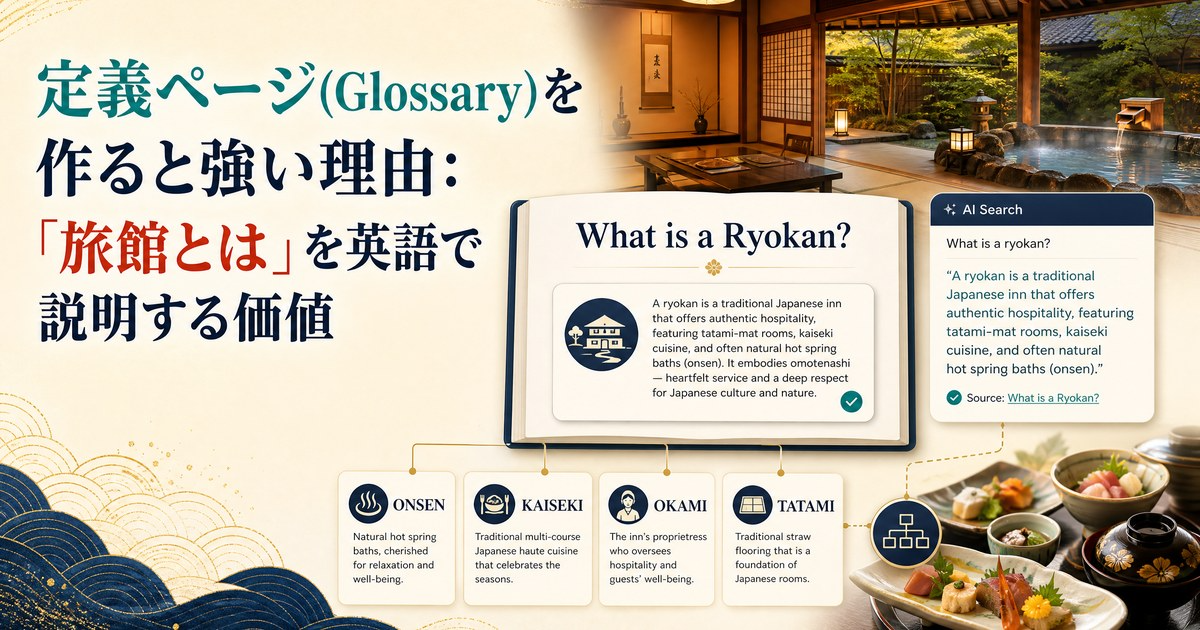
"What is a ryokan?" — For many Japanese people, this question may seem too basic to warrant explanation. However, a clearly defined English definition page addressing this fundamental query can become a powerful content asset in the age of AI search. In this article, we will explore the reasons behind this and how to create such a page effectively.
Why Definition Pages Are Strong in AI Search
Various analyses indicate that definition pages are one of the content formats that AI search engines are likely to cite. Major AI search engines like ChatGPT, Google AI Overviews, and Perplexity tend to use the content of concise and structured definition pages as the basis for answering questions that ask, "What is ___?" Notably, Perplexity has been observed to frequently cite glossary-type content when responding to such inquiries.
This makes sense when you consider how AI constructs answers. AI seeks out clearly defined information sources that are succinct and straightforward. A complete sentence structured as "___ is ___" is much easier to extract and quote than a lengthy explanatory paragraph.
The Value of Explaining 'What is a Ryokan' in English
As mentioned in the Guide to English Keywords for Ryokan and Inns to Attract International Guests, there is a significant disparity in understanding the term "ryokan" among international travelers. Many travelers who are unfamiliar with Japanese lodging culture are at the stage of searching for or asking AI, "What is a ryokan?" Having a clear definition page prepared can create an initial touchpoint with travelers who are still in the early stages of their consideration.
Principles for Writing a Good Definition Page
1. Present a Concise Definition First
Similar to the principles discussed in What is the Structure of Texts Cited by AI? The 'Answer First' Writing Technique, it is crucial to present the core definition succinctly within the first 1-3 sentences of the definition page.
Example: "A ryokan is a traditional Japanese inn, typically featuring tatami-mat rooms, communal or private hot spring baths, and multi-course kaiseki dinners served in-room or in a dining hall."
2. Include Specific Examples
In addition to the definition, providing specific examples of what experiences can be had at a ryokan makes the content more practical and likely to be cited.
3. Organize Related Terms
Alongside the definition page for "What is a ryokan," it is beneficial to create a page that explains related terms (such as onsen, kaiseki, okami, and daiyokujou). This helps both AI and travelers better understand the vocabulary surrounding the concept of ryokan. The explanations discussed in How to Explain 'Tatami,' 'Futon,' and 'Daiyokujou' in English can be directly applied to this glossary page.
4. Consider Structured Data (DefinedTermSet)
For technical implementation, using structured data like Schema.org's DefinedTermSet can more clearly communicate to search engines and AI that this is a definition of a term. It is advisable to consult with a production company for specialized implementation.
Examples of Definition Pages to Include on a Ryokan Site
- What is a Ryokan? (旅館とは)
- What is Onsen? (温泉とは)
- What is Kaiseki? (会席料理とは)
- What does "Okami" mean? (女将とは)
- Ryokan vs Hotel: What's the Difference? (旅館とホテルの違い)
Don't Forget Ongoing Updates
A definition page should not be created and then left unattended. Regularly reviewing and refining the content for clarity and ease of understanding is essential for maintaining citations from AI. Incorporating the review of such definition pages into the improvement cycle discussed in The Monthly Improvement Cycle for International Marketing is a good practice.
Conclusion: The Value of Basic Questions
Creating a page that clearly answers the seemingly simple question, "What is a ryokan?" in English is one of the often-overlooked yet highly effective strategies in the age of AI search. Start by checking if your own site has such basic definition pages.
Studio HAKO's HAKO Scan can provide a free assessment of your site's international readiness, including the richness of such content. Begin by evaluating your current status.