
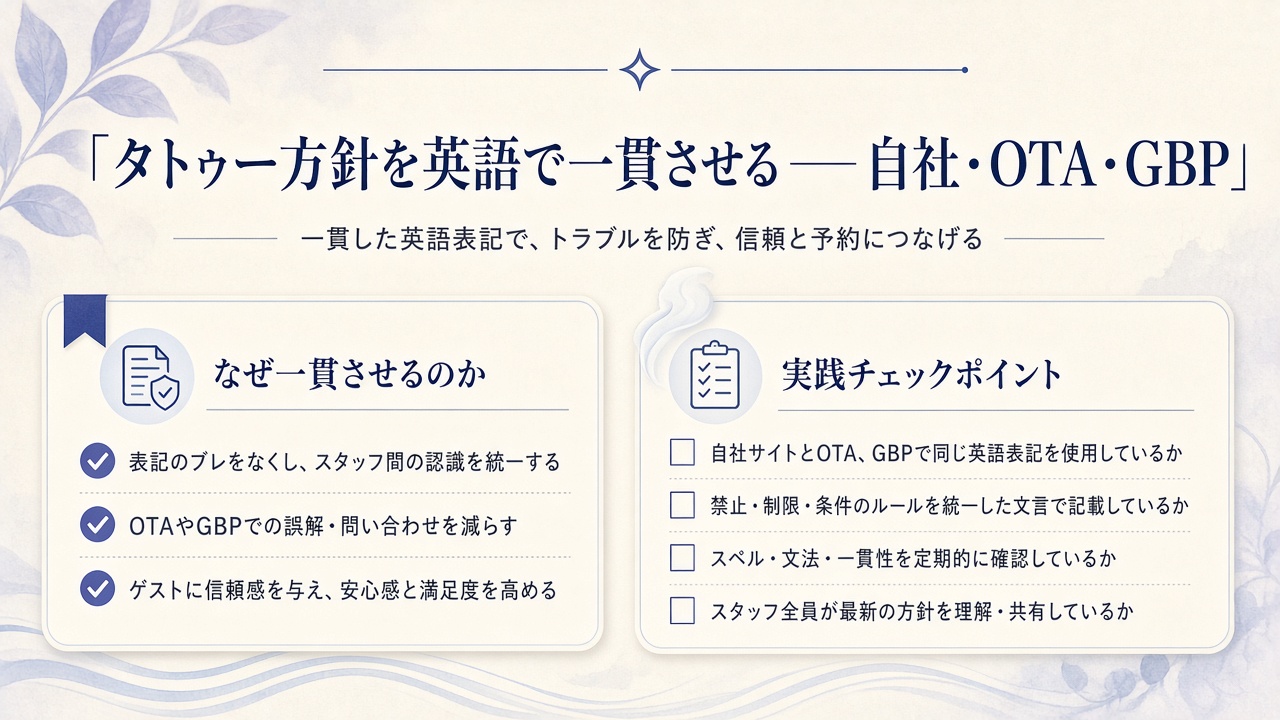
Tattoo-related inquiries and issues often arise in the context of inbound tourism at onsen ryokans. The core problem is not simply whether tattoos are prohibited or allowed, but rather the inconsistency across your website, OTAs, Google Business Profile (GBP), and verbal communication at the front desk. When guests read "it's okay" before booking, but are told upon arrival that tattoos must be covered or are not allowed, it can lead to chargebacks and one-star reviews.
This article aims to provide a guide for establishing a one-sentence English policy that can be easily screenshot, along with alternatives, to ensure consistency across all channels. This will enhance the "trust" aspect of your international readiness through policy uniformity.
Why Channel Inconsistencies Lead to Chargebacks and Low Ratings
International guests often consult multiple sources before making a reservation. If they see even one source stating "tattoo OK," that becomes their expectation.
| Source | Common Discrepancies | Guest Interpretation |
|---|---|---|
| Company English Onsen Page | Focuses on etiquette, policy unclear | Probably okay |
| OTA Facility Description | Old text still says "tattoos welcome" | Officially permitted |
| GBP Attributes/Posts | No mention or only photos | Unclear = no inquiry needed |
| Front Desk Verbal | Different staff provide different information | Feels discriminatory/like a bait-and-switch |
When discrepancies arise, discussions shift from "cultural differences" to "breach of promise." In English reviews, guests tend to criticize what was not written in advance more than the content of the policy itself.
Common Scenarios That Occur on the Ground
- Website states Cover stickers required, OTA mentions nothing → Conflict arises when stickers are refused upon arrival
- Private baths are allowed, but there's no mention of this in English → Miscommunication leads to spreading the word that the ryokan is "not tattoo-friendly"
- Staff A says OK, Staff B says NO → Trust erodes as guests wonder, "Whose word is correct?"
- One family member has a tattoo → The entire bathing plan collapses, leading to dissatisfaction before meals
Before changing the policy itself, it is essential to fix the current policy into one clear sentence and use the same wording across all channels.
Choose One Policy — A Screenshot-Friendly Sentence
First, decide internally on one of the following options (or a clear hybrid). Vague phrases like "case by case" are not suitable for public disclosure. If you opt for a case-by-case approach, you must include criteria for judgment and a response deadline to make it a policy.
Policy Types with One-Sentence English Examples (Copy-Paste Ready)
A. Communal Bath Use Allowed (No Restrictions)
Guests with tattoos may use our communal baths.
B. Cover (Stickers/Rash Guards) Required
Guests with tattoos may use communal baths if tattoos are fully covered with stickers or a rash guard. Cover stickers are available at the front desk.
C. Private Bath Only
Guests with tattoos cannot use the communal baths; private bath rental is available — please reserve in advance.
D. Not Allowed (Always Include Alternatives)
We are unable to allow tattooed guests in our baths. If this affects your stay, please contact us before booking so we can advise alternatives or a suitable cancellation path.
The one-sentence policy should be concise enough for guests to save on their smartphones. If it is placed only at the end of a lengthy policy, it may go unread. Position it at the beginning of the onsen page or near the top of the FAQ.
How to Phrase a Hybrid Policy
Small tattoos that can be fully covered: communal baths OK with cover.
Large/multiple tattoos: private bath only (reserve ahead).
Not sure? Email a photo description before booking — we reply within [24] hours (JST business days).
If you use the phrase "please send a photo," include a brief note about the response SLA and how personal information will be handled (e.g., not stored).
Always Include Alternatives with Restrictions
Ending a communication with just a "No" will deter direct bookings and encourage negative reviews. Always pair restrictions with one of the following alternatives (only those that are feasible):
| Restriction | Example Alternatives | Key Points to Include in English |
|---|---|---|
| Communal Bath Not Allowed | Private Bath | Pricing, reservation methods, how many hours in advance |
| Cover Required | Free/Paid Stickers | Where to obtain them, whether large tattoos are acceptable |
| Time Restrictions | Private Slots/Family Baths | Whether reservations are necessary |
| Completely Not Allowed | Carefully guide to nearby tattoo-friendly facilities | Avoid guarantees for recommendations / mention if your rooms have private baths |
Alternative for tattooed guests
Private bath: ¥[X] / [minutes], reserve by email at least [X] hours ahead.
Room with open-air bath: see room types [link].
Cover stickers: available at check-in [free / ¥X].
On days when alternative options are unavailable, inform guests before booking about the potential for "fully booked" to prevent surprises on the day of arrival.
Placement: Align Your Website, OTA, and GBP with the Same Text
Once you have decided on a one-sentence policy, copy and paste the same text into the following locations. Rephrasing can lead to further discrepancies.
- Company English Onsen/Bath Etiquette Page (highest priority: full text + alternatives)
- English FAQ (Tattoo policy Q&A)
- OTA Facility Description/House Rules (one sentence within character limits + mention of alternatives if applicable)
- GBP: Supplement in Q&A, posts, or attributes to avoid misunderstandings (no need for excessive promotional language)
- Pre-Booking Emails: Short reminders for relevant inquiries or all reservations
- Front Desk Printed Cards: Same English text as on the website
Example of a Shortened Version for OTAs
Tattoo policy: [one sentence]. Private bath alternative available / cover required — details on our website.
Using softer language for OTAs and stricter language for your own site is the most dangerous approach. Choose to align all channels with the stricter side or reconsider the policy itself.
Common Mistakes with GBP
- Rich in photos but zero policy → Expectations inflate before inquiries
- Old posts still stating "tattoo friendly" → Delete or correct these posts
- Attributes and reality do not match → Regular checks are necessary
Conduct a monthly search of your EN site, two OTA platforms, and GBP for occurrences of the words tattoo, irezumi, or ink to visually confirm accuracy.
Front Desk Phrase Cards (Align with Public Policy)
When the front desk communicates differently from the website, everything resets. Place the following card at the reception and ensure it is read and shown during operations.
Our tattoo policy (same as website):
[Paste the one-sentence policy]

If you need a private bath, we can check availability:
Please wait a moment — I will confirm the time and price in writing.

Cover stickers are here. Please cover tattoos completely before entering the communal bath.
The principle is to avoid improvising a different policy while apologizing for what cannot be done. Saying, "Tonight only we can make an exception" can lead to unfair reviews from the next guest. If exceptions are allowed, establish who can grant them and under what conditions as internal rules, ensuring that these conditions can also be communicated in English.
Escalation
- Conflict during policy explanation → Call for a manager (even if they struggle with English, they can point to the printed policy)
- Discrepancies with OTA wording at the time of booking → Confirm the facts and, if necessary, document partial refunds
- If a social media post is suggested → Provide the URL of the policy page without engaging in further debate
Common Failures and Corrections
Failure A: Strict in Japanese, but seems welcoming in English
→ Decide whether to unify under the stricter side or genuinely relax the policy as a management decision.
Failure B: Private bath only but no reservation method provided
→ Provide pricing, slots, and contact information in English. Prepare a cancellation note for days with zero availability.
Failure C: Cover required but insufficient sticker sizes
→ Clearly state the realistic acceptability for larger tattoos in one sentence.
Failure D: Different answers from staff
→ Share the phrase card and the "same as the website" rule during morning meetings.
Failure E: Policy page only in Japanese
→ Publish the one-sentence policy and alternatives on the English onsen page. Link from the FAQ as well.
Implementation Checklist (10 Days)
- Hold a meeting to decide on the policy type (A–D or hybrid)
- Finalize the one-sentence English policy + alternative block
- Place the same text in your EN site, FAQ, OTA, GBP, pre-booking emails, and front desk cards
- Record inquiries and same-day issues for one week, counting those that could have been prevented with clear wording
- If reviews mention tattoo/bath, audit for channel discrepancies
Standard Response for Pre-Booking Inquiries
Tattoo confirmation emails can easily become emotional, so respond with a standard message first, stating the policy, and then address alternatives individually.
Subject: Tattoo / bath policy — [Property Name]

Dear [Name],

Thank you for asking before booking.
Our policy is: [ONE SENTENCE POLICY].

Alternative: [private bath / cover stickers / room with bath — or “not available”].
If you would like to proceed, tell us your dates and we will confirm availability.

Kind regards,
[Property Name]
Keeping a record of this response can help prevent claims of "I wasn't informed" on the day of arrival. If possible, use the same one-sentence policy in OTA messages as well.
How to Address Reviews After They Come In
Even if a low rating has already been given, standardizing your policy is still effective. New guests will see both old reviews and the new policy page.
- First, standardize the published one-sentence policy + alternatives
- For relevant reviews, respond briefly with facts and the current policy URL (only on possible channels) without being confrontational
- Remove or correct any old "tattoo friendly" expressions from OTAs
- Observe if inquiries in the following month shift from "can I?" to "how do I reserve a private bath?"
Separate management decisions to relax the policy from those that only involve correcting the wording. Making the wording friendly while keeping the actual policy strict will lead to renewed discrepancies.
Progressing Internal Agreement (Creating a Policy That Can Be Followed)
If only the web team decides on the policy wording, it may result in a text that the front desk and bath staff cannot adhere to. In a brief agreement session, please decide on the following:
- Communal Bath: Allowed / Cover Required / Not Allowed
- Private Bath: Available / Not Available / How many hours in advance to reserve / Pricing
- Stickers: Availability and size limits
- Authority to grant exceptions (none in principle, or only the manager)
- Final draft of the English one-sentence policy (do not add anything verbally)
Once decided, request the OTA, GBP, and reservation email staff to "paste the same text" and track completion in a table. More than the content of the policy, who updates which channel will determine the success of the operation. What remains even as staff changes are the printed cards and the published URL.
Tattoos Only on Children or Companions
Cases where only one person in a family or couple has a tattoo are becoming more common. Make it clear in the policy text that it applies to each individual guest, ensuring that the presence of a tattooed companion does not prevent the entire group from bathing.
This policy applies to each guest using the baths.
Companions without tattoos may use communal baths as usual.
Private bath bookings can include the whole party when reserved.
By asking in advance about the number of guests and "who is affected," you can reduce the need for explanations on busy days.
Also Consider Other Trust Factors Alongside the Policy
Even if you correct the tattoo policy, if pricing, cancellation, bath hours, and photo expectations are weak, direct bookings will not increase. To comprehensively identify weaknesses in discovery, trust, and booking, the free HAKO Scan (/scan) can serve as a starting point. Comparing international readiness before and after policy adjustments will help prioritize the next gaps to address.
Studio HAKO — Japan, ready for the world.