
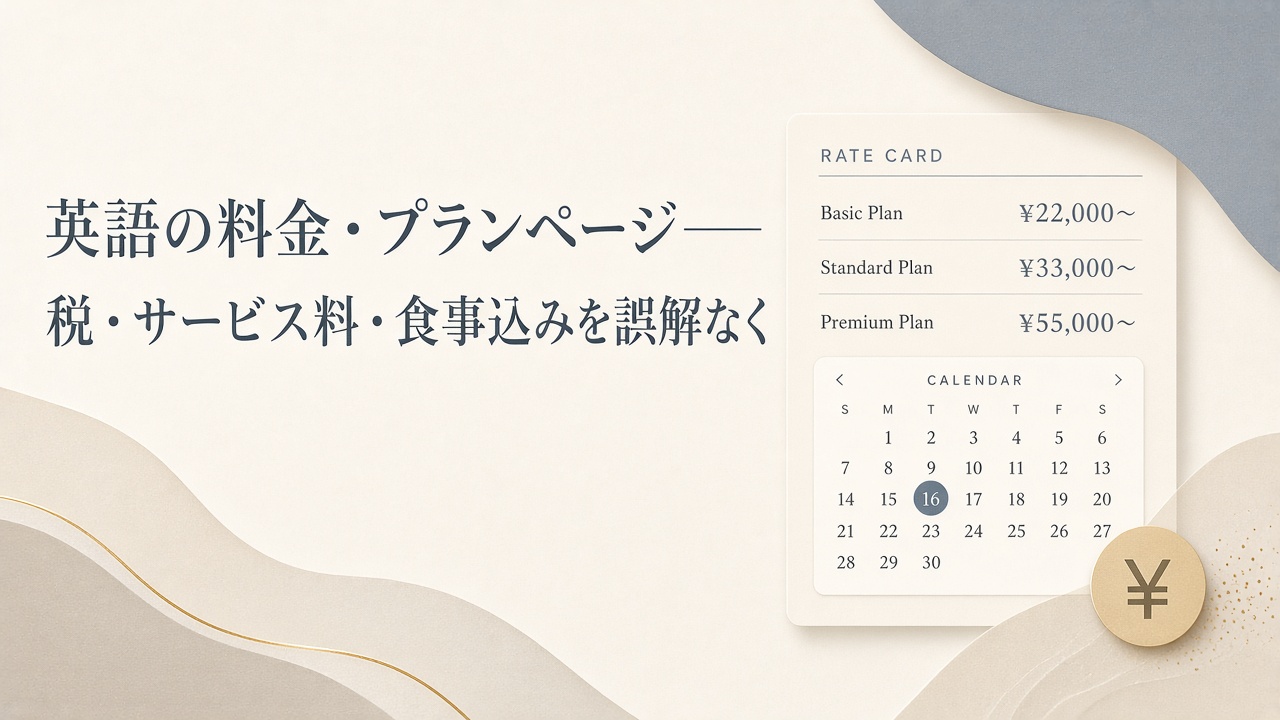
When international guests open the English rates page on your website, they are primarily looking for one thing: how much will they ultimately pay? A page that simply states "From ¥XX,000" will lose out to OTA pricing cards that clearly display total costs (including tax, meals, and cancellation policies). To increase direct bookings, it is essential to design your English rates and plans not just as a translation but as a clear operational specification that avoids misunderstandings.
This article serves as a practical guide for ryokan and onsen operators, detailing how to communicate rates per person or per room, meal inclusions, consumption tax, service charges, bathing tax, children's pricing, and peak season rates consistently across English websites, OTAs, and confirmation emails. This area directly impacts the "trust" and "booking" aspects of international readiness, and it is more cost-effective to align information on-screen before booking than to rely on verbal explanations at the front desk.
Why Ambiguous "from ¥XX,000" Loses to OTAs
International guests excel at comparing prices. When the same accommodation is listed on Booking.com, Expedia, and your own site, the following differences can lead to lost direct bookings. The competition is not just about the price itself but about whether guests need to recalculate conditions themselves.
| Comparison Axis | Common OTA Presentation | Common Weaknesses on English Sites |
|---|---|---|
| Currency | Clearly stated in JPY, total estimate provided | Only ¥ or mixed with USD conversion |
| Unit | Clearly states per person / per room | Unclear unit for "from" |
| Meals | Breakfast included, etc. | Meals included but unclear if breakfast or dinner |
| Taxes & Fees | Link to breakdown of taxes and fees | Ambiguous tax included? |
| Cancellation | Policy listed next to price | Buried on a separate page |
| Children | Pricing by age range | Please inquire |
Direct bookings are not just about being cheaper; they are about avoiding the need for guests to recalculate the same conditions themselves. Ambiguity leads to increased inquiries, and delays in responses can direct guests back to OTAs. Even if you have English-speaking staff, if the pricing assumptions are not clearly laid out on the site, you will end up repeating the same explanations over the phone and via email.
Common Misunderstandings in Practice
- Guests read "From ¥28,000" as "28,000 yen for two people," only to find out at check-in that it is per person.
- Stating "Tax included" but verbally explaining that the bathing tax (local tax) is separate leads to negative reviews of "different from the site."
- "Dinner included" but pricing for meal-less plans is mixed in the same category.
- A service charge of 10% is added after a tax-excluded display, leading to discrepancies with the total in the confirmation email.
- Children's pricing is only available upon inquiry, excluding families from comparison charts.
- Peak season surcharges are not mentioned on the English page, appearing as additional charges after booking confirmation.
These issues stem not from customer service skills but from poor design of the English pricing block. International guests are quick to feel "cheated," and a single pricing issue can lead to negative ratings across multiple channels.
Common Symptoms of Weak Direct Booking Pages
- The hero section only states "Seasonal rates from..." with no plan cards.
- Japanese plan names remain in romaji, making it unclear what is included.
- Cancellation and pricing are separated on different pages, causing guests to abandon the process when they hit the back button.
- While OTAs show total prices including tax, your site only has a small note at the end of the text.
- Confirmation emails remain in Japanese templates or lack a breakdown of the total amount.
The first step to improving international readiness is not to throw the entire content to a translation company but to address the above symptoms with a single checklist.
Must-Write Items
On your English Rates / Plans page or within each plan's details, ensure the following items are included. While amounts may vary by facility, missing items can undermine trust. Meeting these requirements will shift inquiries from "how much is it?" to "is it available on this date?"
1. Currency in JPY
All rates are shown in Japanese Yen (JPY).
Card payments are charged in JPY. Your bank may apply its own FX fee.
If you include USD, clarify that it is for reference and that payments are made in JPY. If you cannot update the conversion daily, it is safer not to include it at all, as fluctuations can lead to complaints about discrepancies between the site’s dollar display and actual charges.
2. Per Person or Per Room
While ryokan typically charge per person with two meals included, international guests often default to thinking in terms of room rates. Fix the unit directly below the plan name. If the units differ between the room type page and the plan page, the burden of recalculation increases significantly.
Rate basis: per person, per night (based on 2 guests sharing a room)
Single occupancy: +¥[X] per night (or see Single Occupancy section)
3. Meal Inclusions
Meals: Dinner and breakfast included (Japanese kaiseki / ryokan breakfast)
Meal times: Dinner [18:00–19:30] / Breakfast [07:30–09:00] (last seating may vary)
Allergy / dietary requests: please email at least [X] days before arrival
Stating only "Meals included" does not clarify if it is breakfast, dinner, or whether meals are served in the room or in a dining area. If room service incurs an additional charge, mention it in the exclusions. Clearly state the availability of vegetarian or halal options along with the deadline for requests, avoiding vague promises like "We’ll try."
4. Taxes and Service Charges
Tax display practices vary by facility in Japan. In English, choose one of the following in a single sentence and ensure that all channels use the same terminology. Having one site show prices inclusive of tax, another show prices exclusive, and a confirmation email display only the total can lead to confusion.
Option A — Inclusive style:
Rates include consumption tax and service charge.
Bathing tax (nyuto-zei) of ¥[X] per adult per night is collected separately at check-in / already included — [choose one].

Option B — Exclusive style:
Rates exclude consumption tax ([X]%) and service charge ([X]%).
Estimated total is shown at booking before you confirm.
Local bathing tax ¥[X] per adult per night applies.
In municipalities with a lodging tax, include Accommodation tax in the same block. Guests want to know whether there are any additional charges at checkout, not a detailed tax rate table. A single sentence before booking is more effective than explaining at the front desk that it is due to regulations.
5. Notes on Bathing Tax and Lodging Tax (short and specific)
Local taxes:
- Bathing tax (nyuto-zei): ¥150 per adult per night (example — use your municipality amount)
- Children under [age]: reduced / exempt as per local rules — [state]
A vague statement like "Local tax may apply" appears weaker than the breakdown provided by OTAs. Even if the amounts vary by municipality, please specify the exact amount your facility collects.
English Template for Plan Blocks (Copy-Paste)
Present each plan as a single card, maintaining the following order to avoid being skipped: Name → Inclusions → Exclusions → Cancellation link → Book CTA. This order aligns with the flow of information that international guests are accustomed to on OTAs, reducing psychological barriers to direct booking on your site.
[Plan name in English]
e.g. Standard Twin — Dinner & Breakfast

From ¥[XX,000] per person / night (JPY)
Based on 2 adults sharing. Single occupancy from ¥[YY,000].

Includes
- Overnight stay in [room type]
- Dinner and breakfast
- Access to large communal baths / private bath time if applicable
- Consumption tax and service charge [included / shown at checkout — match your policy]

Does not include
- Drinks beyond set meal
- Private bath reservation fee (if optional)
- Transportation
- Bathing tax ¥[X] / adult / night [if separate]

Children
- Ages [A–B]: ¥[amount] (meals: [yes/no / kids meal])
- Ages [C and under]: [co-sleep free / futon fee] — see Children rates

Cancellation
See our Cancellation Policy (link). Free cancellation until [cutoff, JST].

[Book this plan]  or  [Inquire]
Naming Your Plans
Using only romaji for plan names (e.g., Yuki Plan) does not convey meaning to international guests. Instead, use an English name that conveys benefits + a short description. Keep internal code names separate from publicly displayed English names and align them with OTA plan names where possible.
| Weak Example | Strong Example |
|---|---|
| Yuki Plan | Snow View Twin — Dinner & Breakfast |
| Special Plan | Private Bath Hour + Kaiseki Dinner |
| Day Use | Day-use Onsen & Lunch (no overnight) |
| Plan A | Garden Room — Breakfast only |
Filling in Details for Children, Single Use, and Peak Seasons
Placing details in a separate PDF or only on Japanese pages can lead to abandonment right before the direct booking form. Show these details within the same hierarchical level on the English rates page, even if in a collapsible format. Phrases like "For more details, please inquire" will easily direct families, solo travelers, and peak demand inquiries back to OTAs.
Children's Pricing (using numbers for age ranges)
Children rates (per child / night, JPY)
- 0–2 years: free if sharing bedding with parents (no meals) / futon +¥[X] if requested
- 3–6 years: ¥[X] (kids meal / adult meal — state which)
- 7–11 years: ¥[X]
- 12+: adult rate

Maximum occupancy per room still applies. Tell us ages at booking.
Align age boundaries with internal rules, futon counts, and meal provisions, avoiding vague verbal explanations like "generally up to elementary school age" in English.
Single Use
Single occupancy
Many ryokan rates assume two guests. For one adult in a room designed for two:
- Extra charge: +¥[X] per night, or
- Dedicated single rooms from ¥[Y]
The demand for solo travel is increasing. If single occupancy is not allowed, clearly state this early and mention alternatives (smaller rooms, day-use options) if available.
Peak Seasons and Calendar
Seasonal notes
Peak dates (Golden Week, Obon, New Year, local festivals) use higher rates.
The calendar on this page shows the rate for your dates before you pay.
“From” prices are the lowest typical rate in the quieter season — not a guaranteed quote for every night.
If possible, embed your booking engine's calendar with an English UI, demoting the "From" prices to a secondary role. If the calendar is only in Japanese, at least list peak dates and promise in English that "confirmed rates will be displayed after date selection."
Synchronizing English Site ↔ OTA ↔ Confirmation Emails
Discrepancies in pricing can lead to negative reviews and chargebacks. Conduct a monthly reconciliation using the following table. The responsible parties should include not only the English site manager but also the reservation staff and front desk leaders, printing the same table for review in meetings.
| Check Item | Your EN | OTA (2 main ones) | Confirmation Email |
|---|---|---|---|
| Per person / room | Match? | Match? | Match? |
| Tax & service included expression | Same terminology? | No contradictions with Taxes and fees? | Breakdown of total? |
| Treatment of bathing tax | Separate / included | Separate / included | Separate / included |
| Meal content | Clearly stated for breakfast and dinner | Matches plan name | Repeated information present |
| Children's age range | Same boundaries | Same boundaries | Information provided |
| Cancellation deadline (JST) | Same | Same | Same |
| Currency JPY | Clearly stated | Clearly stated | Clearly stated |
Essential Sentence to Reiterate in Confirmation Emails
Your stay total: ¥[amount] JPY for [N] adults / [N] children
Includes: [meals / tax-service as per plan]
Local bathing tax: ¥[X] x [nights] x [adults] = ¥[sum] [collected at check-in / included]
Even if booked through an OTA, if possible, send a similar breakdown from your own domain in a "pre-arrival notice" to reduce disputes at the front desk. If the amount changes, include a one-sentence explanation in English (date change, number of guests change, plan change).
Common Mistakes and Corrections
Mistake A: Stated tax included but added bathing tax at the front desk
→ In English, separate Consumption tax / service and Bathing tax. The verbal explanation of "it’s due to regulations" does not hold up well in English reviews.
Mistake B: Plan list remains in Japanese names
→ Ensure a minimum set of English names + Includes 3 lines. A plan list with only pictures will not be compared.
Mistake C: Cancellation policy is a long text on a separate page
→ Link from each plan card to the Cancellation Policy and clearly state the cutoff time in JST.
Mistake D: Peak season details only verbally explained
→ Fix a calendar or Peak dates note on the English page.
Mistake E: Direct bookings are cheaper but the breakdown is weak
→ Before competing on price, ensure you have a clear total that is at least equivalent to OTAs. Price competitiveness works better after ensuring transparency in the breakdown.
Mistake F: Service charge misinterpreted as "tip"
→ Service charge is mandatory, while a tip is voluntary. Do not confuse the two in English.
Implementation Checklist (2 Weeks)
- Audit the Must-state 6 items on the English Rates / Plans page (currency, unit, meals, taxes, bathing tax, cancellation).
- Apply template cards to the top 3 plans.
- Add English blocks for children, single use, and peak seasons to the same page.
- Reconcile expressions with 2 OTAs and confirmation emails, correcting discrepancies.
- Monitor for 2 weeks to see if inquiries about "not understanding the breakdown of costs" have decreased.
- Print the "English text on the site" for the front desk and ensure it matches verbal explanations.
Next Steps
To identify gaps not only on the rates page but also in discovery, trust, and booking, check your international readiness with the free HAKO Scan (/scan). Comparing scores before and after improving your English rates will help you see where your direct booking pathways are still weaker than OTAs.
Studio HAKO — Japan, ready for the world.