
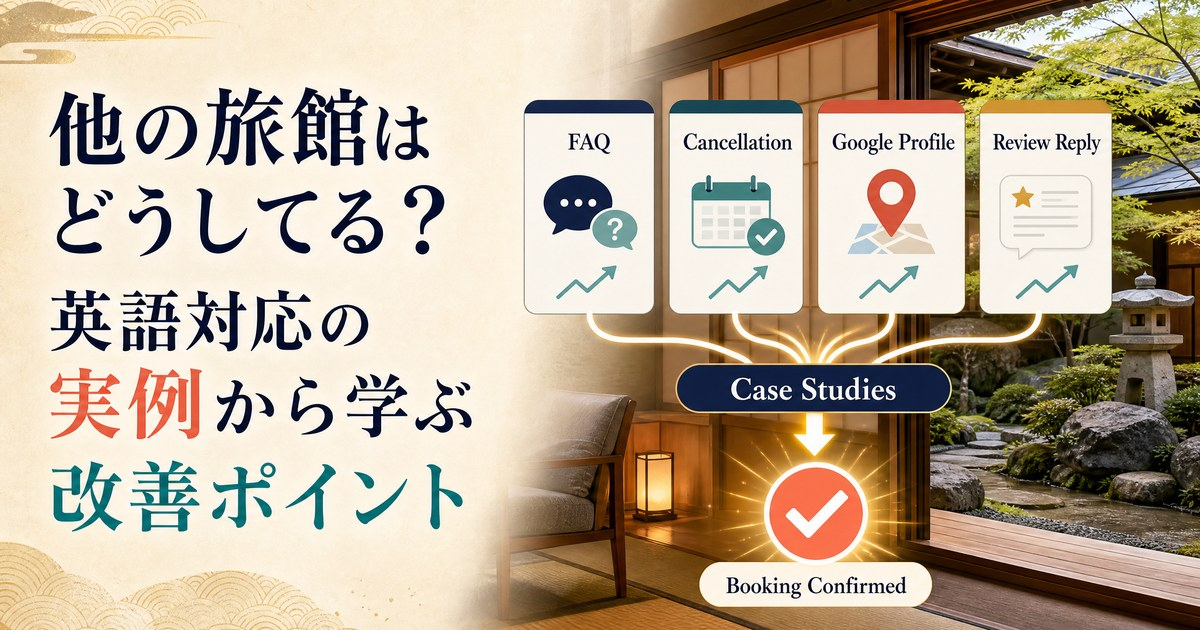
Have you ever wondered, "What strategies are other ryokans implementing for English support?" Many readers may have felt this way while exploring previous articles on improvement strategies.
In this article, rather than naming specific facilities, we will introduce typical improvement patterns commonly observed in the industry through a compilation of multiple case studies. This approach focuses on trends seen across many accommodations, making it easier to learn from these examples.
Case A: Enhancing the FAQ Page to Reduce Inquiry Burden
At a local hot spring ryokan, staff frequently received repeated inquiries such as, "Is there an English-speaking staff member?" and "What are the rules for the large public bath?" By compiling these questions into an FAQ page and proactively providing answers, the number of similar inquiries significantly decreased, easing the burden on staff. Additionally, this alleviation of pre-booking concerns led to an increase in the percentage of guests proceeding to the reservation form.
Key Takeaway: Recording and analyzing actual inquiries to reflect them in an FAQ is a simple yet effective strategy that benefits both customer acquisition and operational efficiency. For more details, check out “10 Essential English Content Items for Your FAQ Page.”
Case B: Clarifying the Cancellation Policy to Reduce Negative Reviews
At a ryokan where the cancellation policy was unclear, negative reviews often mentioned, "I was charged a different amount than I expected." After specifying the reference time and time zone and detailing the rate structure, there was a noticeable decrease in negative reviews related to this issue.
Key Takeaway: Clarifying potentially confusing information not only improves booking rates but also helps prevent post-issue troubles and negative reviews. For a deeper understanding, read “The Importance of Clearly Stating Your Cancellation Policy in English.”
Case C: Strengthening English Support on Google Business Profile
A small ryokan had made strides in providing English support on its official website but had left its Google Business Profile in Japanese. After adding English descriptions for operating hours, photo captions, and responses to reviews, there was an observed increase in inquiries through Google Maps. This highlights how many international travelers often compare options on Google Maps before visiting an official site, indicating this entry point is often overlooked.
Key Takeaway: It’s crucial to enhance your Google Business Profile as an entry point alongside improvements to your official website. Don’t miss our “Checklist for Correctly Setting Up Your Google Business Profile in English.”
Case D: Thoughtful English Responses to Reviews Increase Repeat Business and Referrals
At a ryokan where responses to reviews were typically generic, switching to more personalized replies that referenced specific content led to an increase in mentions of "the staff's excellent service" within reviews. This trend contributed to building trust indirectly.
Key Takeaway: It’s important to recognize that responses to reviews are read not only by the reviewer but also by potential guests considering a reservation. For specific templates, see “How to Respond to English Reviews? Basics of Responding to Overseas Reviews.”
Two Common Points Across All Cases
The common threads in these examples are “clarity” and “continuity.” Making vague information specific and committing to ongoing reviews of improvements can lead to noticeable enhancements in many accommodations without the need for special system investments.
Conclusion: Check for Applicable Improvement Patterns in Your Own Business
The four cases presented illustrate typical patterns observed in various ryokans, but they also highlight potential improvement points that may apply to many accommodations. We recommend checking your own site for similar challenges, one by one.
Studio HAKO’s HAKO Scan offers a free diagnosis of your site’s international support status, including the identification of such improvement points. Start by assessing your current situation.