
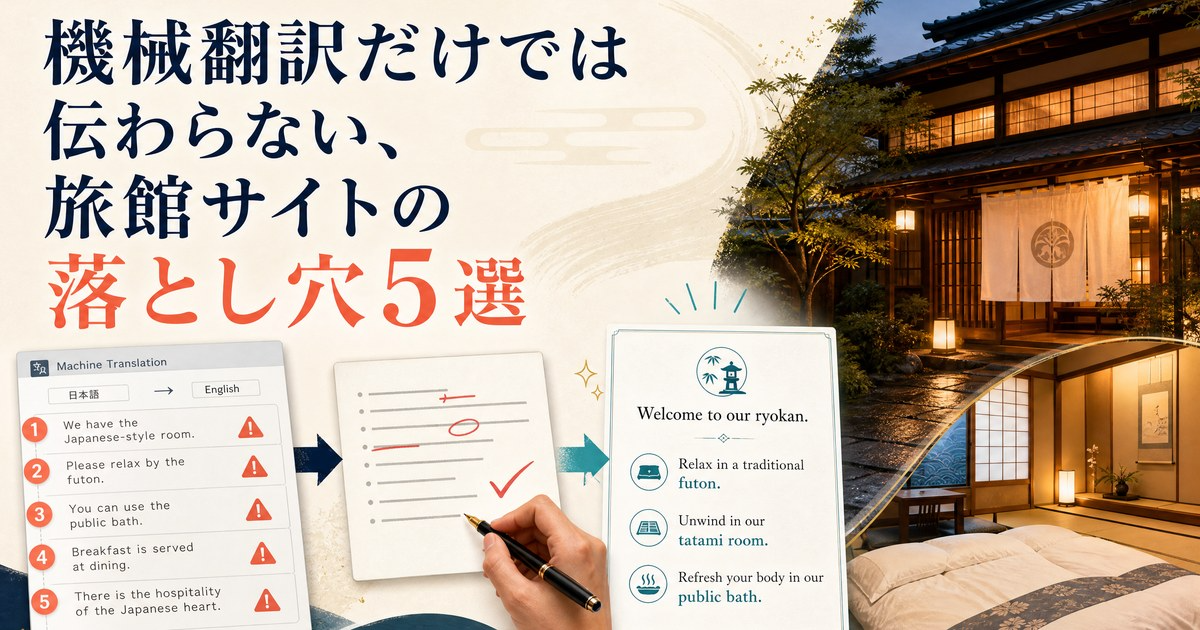
It's understandable to want to rely on machine translation, especially considering the cost and effort involved. Many times, simple informational texts can be adequately translated using tools like Google Translate or DeepL.
However, when it comes to English websites for ryokans and inns, merely pasting machine translations can create misunderstandings and distrust among international guests, potentially leading to last-minute cancellations. In this article, we will highlight five common pitfalls of machine translation on ryokan websites and discuss how to improve the translations effectively.
Pitfall 1: Direct Translation of Unique Japanese Terms
Terms that are unique to Japanese accommodation culture, such as "futon," "daiyokufu" (large public bath), and "genkan" (entrance where shoes are removed), may be translated as words but fail to convey their underlying meanings. For instance, translating "futon" mechanically as "futon" can lead guests from Western countries to imagine a "futon sofa." Including a brief explanation of what type of bedding is provided and how it is arranged (e.g., if staff will set it up after dinner) can prevent misunderstandings and provide reassurance.
Pitfall 2: Loss of Nuance in Polite Expressions
When polite requests in Japanese (e.g., "We kindly ask you to...") are translated using machine translation, they can come out sounding unnaturally stiff or, conversely, as abrupt commands. A text that feels warm and polite in Japanese can come across as cold and bureaucratic in English. It is essential to adjust the tone to ensure it feels natural to native speakers.
Pitfall 3: Misinterpretation of Proper Nouns and Place Names
Proper nouns such as ryokan names, nearby station names, and local tourist attractions can be incorrectly transformed or inconsistently presented across different pages by machine translation. Inconsistent naming can lead to dispersed information when international guests search for specific names, negatively impacting SEO. It is crucial to create a list of official English representations for proper nouns rather than relying solely on machine translation.
Pitfall 4: Ambiguous English from Omitted Subjects
Japanese allows for the omission of subjects while still conveying meaning, but English requires a subject for a sentence to make sense. A Japanese sentence like "After your reservation, we will contact you for confirmation" can become unclear in English if the subject is omitted, leading to awkward phrasing. Clarifying the original Japanese text to specify "who, what, and when" before translation can significantly improve accuracy.
Pitfall 5: Misinterpretation of Critical Information Leading to Issues
Misinterpretations of crucial information such as cancellation policies, additional fees, and check-in/check-out times can lead to serious complaints and issues, rather than just readability problems. It is strongly recommended to have critical information checked by a human, preferably a native English speaker or someone familiar with the hospitality industry, to ensure accuracy.
Smart Use of Machine Translation as a Draft
While we have discussed the pitfalls of machine translation, it is not necessary to dismiss it entirely. Using machine translation as a draft and then reviewing it based on the five points mentioned above is a more efficient and practical approach than writing everything from scratch. The key takeaway is to never publish machine translations without thorough review.
Conclusion: Effective English Comes from a Localization Mindset
Machine translation is a convenient tool, but for content like ryokan websites that involve cultural context and important transactional details, the focus should be on "localization"—conveying meaning and context rather than simply replacing words. There’s no need to overhaul every page; start by prioritizing critical pages like cancellation policies and pricing that are prone to misunderstandings.
Studio HAKO's HAKO Scan offers a free assessment of your website's international readiness, including content-related issues on English pages. Check the current status of your site today.