
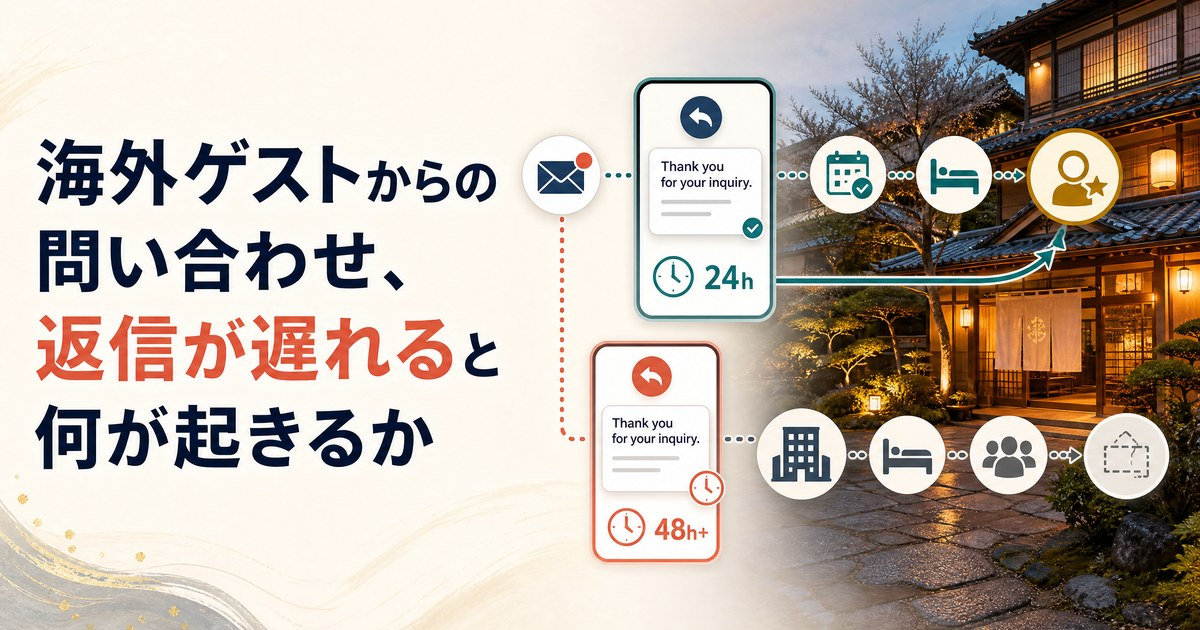
Being busy and responding to inquiries a few days later is a common scenario in the ryokan and lodging industry. However, for inquiries from international guests, this "few days delay" can lead to significant lost opportunities compared to Japanese guests.
In this article, we will systematically outline the actual impacts of delayed responses, the underlying reasons, and specific measures to address these issues.
Why is Response Speed Particularly Important for International Guests?
Japanese guests often confirm details via phone or make decisions based on familiar brands or OTA reviews without thoroughly comparing multiple options. In contrast, international guests tend to prioritize gathering information and confirming details through inquiries due to language barriers. Thus, the act of inquiring often occupies a central role in their decision-making process.
Moreover, international travelers typically compare multiple accommodations simultaneously. It’s not uncommon for them to send inquiries to several places at once. Therefore, response speed is directly linked to a "first-come, first-served selection competition".
What Happens When Responses Are Delayed: Impacts Over Time
Within a Few Hours to 1 Day: Starting to Fall Out of Consideration
Many international guests are evaluating multiple options at the same time. If a response does not arrive during this period, they may receive replies from other accommodations first, leading to further engagement with those options. While they haven't completely ruled out your option yet, the first impression of being a "responsive accommodation" may be claimed by competitors.
2 to 3 Days: Inquiries May Be Forgotten or Guests May Decide on Other Accommodations
After a few days, guests may have already moved on to other options and, if conditions are favorable, may finalize their bookings. Travel planning often involves juggling multiple tasks (flights, accommodations in other cities, transportation, etc.) within a limited timeframe, causing accommodations that do not respond to naturally fall off the consideration list.
More Than a Week: The Impression of Being an "Unresponsive Accommodation" Becomes Fixed
If there is no response by this stage, guests are likely to have booked elsewhere, and even if you respond later, it is often too late. Worse yet, the experience of "not receiving a response after inquiring" can spread as negative information through social media, word of mouth, or direct reviews.
Four Specific Impacts of Delayed Responses
1. Direct Opportunity Loss (Missed Bookings)
The most direct and apparent impact is missing out on bookings. Especially during busy seasons or events, many guests inquire with multiple accommodations simultaneously, making response speed a decisive factor in securing reservations.
2. Damage to Brand Image and Trustworthiness
Experiencing slow or no responses can lead to concerns like, "Is this accommodation well-managed?" For international guests, who have limited means to build trust with a new and unfamiliar accommodation, the impression of how inquiries are handled often directly affects their overall trust in the establishment.
3. Negative Impact on Reviews
Regardless of whether they actually stayed, experiences like "I inquired but received no response" can be mentioned in Google reviews or on social media. While posts from guests who did not stay can sometimes be removed, without fundamentally improving response speed, similar issues will continue to arise.
4. Increased Workload for Staff
When responses are delayed, guests may follow up or send duplicate inquiries. As a result, interactions that could have been resolved in one exchange may multiply, leading to an increased workload for staff and creating a vicious cycle.
Why Are Responses to Inquiries from Overseas Often Delayed?
Time Zone Differences
Inquiries from international guests often arrive outside of Japanese business hours, creating a natural time lag in responses.
Lack of Staff Proficient in English
If only a few staff members are comfortable responding in English, inquiries may pile up for specific individuals, leading to delays if those staff members are unavailable or busy.
Psychological Barriers of "I Should Respond Properly Later"
The pressure to respond in perfect English can lead to procrastination. However, in many cases, a prompt acknowledgment (like confirming receipt) is more important to guests than perfect English.
Strategy 1: Use Auto-Responses to Confirm Receipt Immediately
If providing detailed responses to all inquiries immediately is challenging, setting up an auto-response such as "Thank you for your inquiry. We have received your message and will respond within 24 hours." can significantly alleviate guest anxiety. The difference between feeling "ignored" and having the assurance that "there is a prospect of receiving a response" is substantial.
Strategy 2: Enhance the FAQ Page to Reduce Inquiries
If all questions can be resolved without inquiries, there will be no need to wait for responses. Preemptively answering common questions, as discussed in "10 Essential English Content Items for Your FAQ Page", can reduce the number of inquiries and lighten the response burden.
Strategy 3: Clearly State Expected Response Times in Advance
By indicating expected response times on your website or FAQ, such as "We will respond within 24 hours" or "If received outside of business hours, we will respond by the next business day", guests can feel assured while waiting, even if immediate responses are not possible. Communicating expectations in advance significantly influences the perceived "slowness".
Strategy 4: Prepare Templates to Lower the Barrier for Initial Responses
Having pre-written English templates for common inquiries can reduce the burden on staff and lead to quicker responses. The concepts discussed in "How to Respond to English Reviews? Basics of Responding to International Reviews" can be applied not only to reviews but also to inquiry responses.
Strategy 5: Prioritize Responses
If responding to all inquiries at the same speed is challenging, it is efficient to prioritize inquiries that are likely to lead to bookings (like availability checks or pricing inquiries) and defer general questions.
Ideal Response Time Guidelines
While there is no strict industry standard, a response within 24 hours is generally considered a realistic and effective guideline for meeting the expectations of international guests. For inquiries received outside of business hours, responding early the next business day can often minimize lost opportunities.
Conclusion: Speed is Part of Hospitality
The speed of responses is not just an issue of operational efficiency; for international guests, it is a crucial part of building trust, as they wonder, "Will this accommodation genuinely engage with me?" Rather than delaying responses in pursuit of perfect English, it is more beneficial to send at least an acknowledgment of receipt quickly—this mindset shift can prevent many lost opportunities.
Studio HAKO's HAKO Scan offers a free assessment of your site's international response capabilities, including inquiry handling. Start by checking your current situation.