
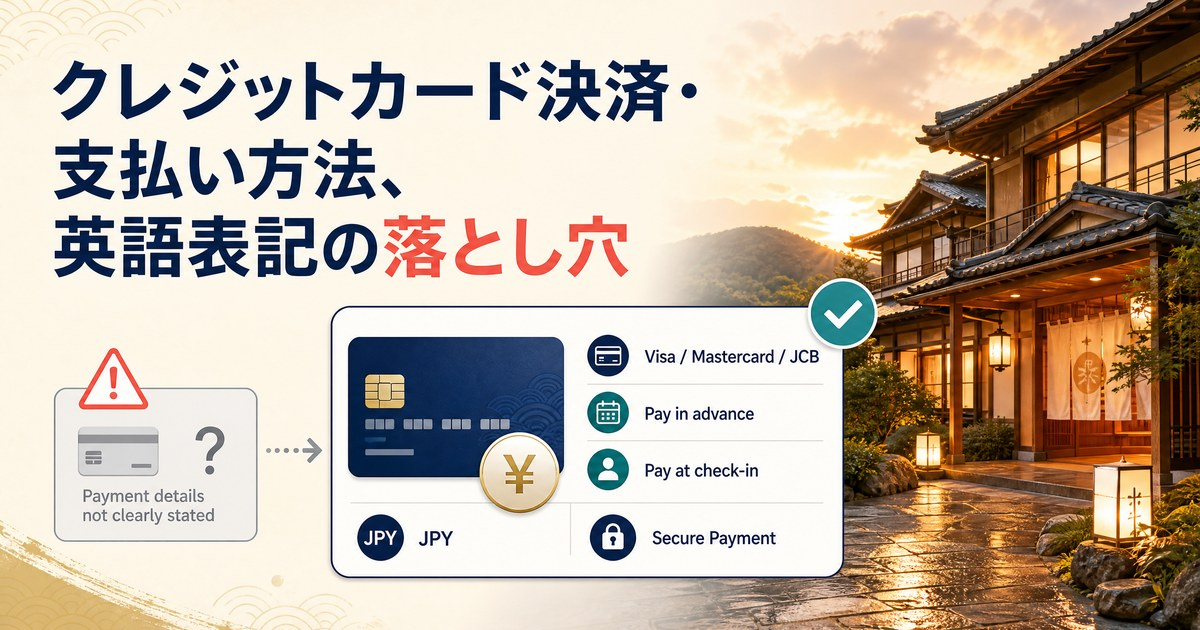
The phrase, "Payment methods will be explained on-site," is frequently seen on Japanese websites, but for international guests, this can be a major source of anxiety. They may wonder whether only cash is accepted, if credit cards can be used, or if payment is required in advance. If payment conditions are unclear right before booking, guests may abandon their reservations altogether.
In this article, we will explore common pitfalls in English expressions related to credit card payments and payment methods, along with suggestions for clearer wording.
Pitfall 1: Lack of Specific Card Brands
Simply stating, "We accept credit cards" does not address the primary concern for international guests: whether their specific card can be used. Be sure to list the actual brands you accept, such as Visa, Mastercard, JCB, American Express, and Discover. Particularly, many establishments in Japan do not accept American Express, and failing to communicate this can lead to payment issues on-site.
Improved Example: "We accept Visa, Mastercard, and JCB. American Express and Discover are not accepted."
Pitfall 2: Ambiguity in Payment Timing
If it is unclear whether payment is required in advance (at the time of booking) or on-site (at check-in or check-out), guests cannot predict when and how they will need to pay. If conditions vary by plan, it is crucial to specify this for each option.
Improved Example: "Payment is required in full at the time of booking." or "Payment will be collected at check-out. A valid credit card is required to guarantee your reservation."
Pitfall 3: Not Mentioning Cash-Only Situations
While many ryokans accept credit cards, there are often instances where only cash is accepted, such as for vending machines, additional drinks, souvenirs, or certain facility fees. If this is not communicated in advance, guests may find themselves in a difficult situation without cash on hand.
Improved Example: "While room charges can be paid by credit card, some in-house services such as vending machines and the gift shop are cash only. We recommend bringing some Japanese yen for your stay."
Pitfall 4: Unclear Currency Denomination
If it is not specified that prices are in Japanese yen, guests may mistakenly assume that the amounts are in their own currency, especially if they only see the numbers. Additionally, since exchange rates fluctuate daily, it is helpful to inform guests that the listed prices are approximate based on the current rate.
Improved Example: "All prices are listed in Japanese yen (JPY). The amount charged to your card may vary slightly due to exchange rates at the time of transaction."
Pitfall 5: Lack of Assurance on Online Payment Security
Some international guests may feel uneasy about entering their card information directly on a booking site for an unfamiliar ryokan. Communicating the use of SSL encryption and reliable payment processing companies can provide peace of mind. Even a lock icon or the phrase "Secure Payment" in the footer can enhance their confidence.
Pitfall 6: Insufficient Explanation of Deposits
Some accommodations may require a small deposit or pre-authorization on a credit card to confirm a reservation. If it is not clear whether this is an actual charge or a temporary hold for reservation guarantee, it can lead to confusion and distrust.
Improved Example: "A credit card is required to guarantee your reservation, but no charge will be made until check-out. A temporary authorization hold may appear on your statement."
Pitfall 7: Inconsistent Terminology
Sometimes, machine translations can lead to the use of terms like "cash on delivery" that are inappropriate in the context of accommodation bookings. Payment-related terminology is specialized, so it is essential to review the content after translation and standardize it to commonly used expressions in the hospitality industry (e.g., pay at check-in, pay in advance, guarantee reservation).
Checklist
- Are the accepted card brands clearly specified?
- Is it clearly stated whether payment is required in advance or on-site?
- If there are cash-only situations, is this communicated?
- Is it specified that prices are in Japanese yen?
- Is there information regarding the security of the payment page?
- If a deposit is required, is its nature (guarantee or charge) explained?
Conclusion: Payment Anxiety is the Final Hurdle Before Booking
While information regarding payment methods may seem mundane compared to other enticing content, it is crucial for the final decision-making process just before booking. By avoiding ambiguous wording and providing clear, unambiguous information, you can prevent unnecessary drop-offs.
Studio HAKO's HAKO Scan offers a free assessment of your website's international readiness, including the clarity of information just before booking. Start by checking your current status today.